27 May 2026
India’s energy transition is increasingly being shaped by a complex balance between growth, sustainability, and security. While renewable energy continues to scale, traditional fuels remain central to industrial activity, with coal accounting for over 55% of India’s energy mix and fuelling over 74% of total power generation.
However, high import dependence—~90% crude oil, >50% LNG, ~80–90% methanol, and ~100% ammonia—has exposed structural vulnerabilities, especially during periods of geopolitical disruption.
Against this backdrop, coal gasification is emerging as a strategic pivot—transforming coal from a combustion fuel into a value-added industrial resource.
Source: Public Information Bureau-posted on 4th April 2025, Bloomberg report dated 19th May 2026. LNG (Liquefied Natural Gas)
What is Coal Gasification?
Coal gasification is a process that converts solid coal into a gaseous fuel called syngas. Instead of burning coal directly, it is heated at high temperatures in a controlled environment with limited oxygen and steam. This chemical transformation breaks coal into its core components, mainly carbon monoxide, hydrogen, carbon dioxide, and smaller hydrocarbons. The resulting gas mainly contains carbon monoxide (30–60%) and hydrogen (25–30%), making it a versatile industrial intermediate
Unlike combustion, which releases energy by burning coal, gasification extracts the chemical value embedded in coal. This makes it fundamentally different, which means that coal is no longer just a fuel for electricity, but a raw material for producing industrial chemicals and cleaner fuels.
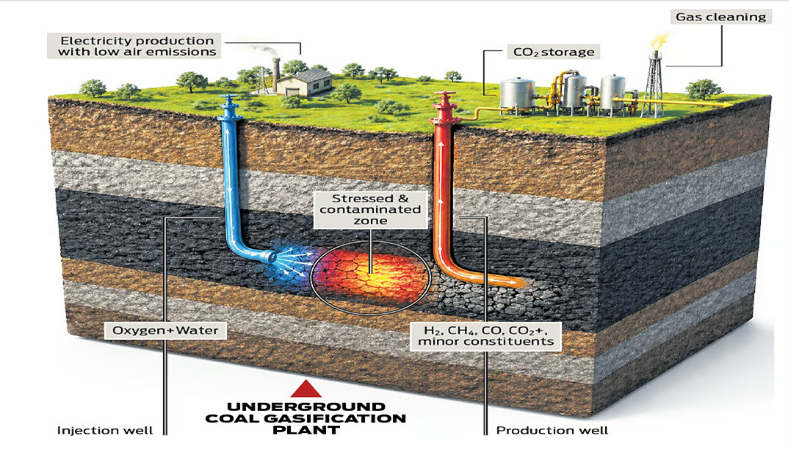
Source: News India Express dated 03rd May 2026
How is it used?
The strategic importance of coal gasification lies in its wide applicability across sectors. Syngas serves as a critical input for:
- Fertilisers: Ammonia and urea production
- Chemicals: Methanol and petrochemicals
- Energy fuels: Synthetic natural gas and hydrogen
- Steel sector: Substitute for coking coal
Global Coal Gasification Market Share:
The global coal gasification market has been witnessing steady expansion, driven by rising demand for alternative feedstocks, industrial fuels, and energy security solutions. Estimates suggest that the market is currently valued in the range of ~USD 40–45 billion globally, with projections indicating growth to ~USD 60 billion by the end of the decade, reflecting a moderate growth trajectory in the mid-single-digit CAGR range. This growth is largely concentrated in Asia-Pacific, which accounts for over ~70% of global capacity, led by large-scale coal-to-chemicals and coal-to-fuels projects, particularly in China and emerging economies. Additionally, the global ecosystem includes over 270 operational coal gasification plants with hundreds of gasifiers deployed, highlighting the established industrial scale of the technology. The market’s expansion is being supported by its ability to produce syngas used in chemicals, fertilisers, power generation, and hydrogen, while also serving as a bridge solution for countries seeking to reduce dependence on imported oil and gas without immediately phasing out coal.
Source: Researchnester
Global Adoption:
Coal gasification has seen uneven adoption globally, primarily driven by resource availability, energy security priorities, and industrial strategy. While some countries have scaled it into core industrial infrastructure, others have adopted it selectively or experimented with evolving technologies.
| Country | Gasification Status | Key Products / Uses | Policy Details |
|---|---|---|---|
| China | Global Leader (accounts for over 90% of ammonia and 70% of methanol via coal) | Ammonia/Urea, Methanol, Syngas for chemicals, SNG (Synthetic Natural Gas), Coal to Liquids (CTL) | Dominates global coal gasification market; state-backed integration for industrial olefin and ethylene glycol production. |
| India | Rapidly Expanding (Early-stage dominance shifting to deployment) | Urea (Fertilizer), Methanol, Hydrogen, Direct Reduced Iron (DRI) | The government has established a National Coal Gasification Mission targeting 100 Million Tonnes (MTPA) by 2030, heavily utilizing high-ash domestic coal. |
| United States | Moderate / Stable (legacy industrial base) | Chemicals, Liquid Fuels, SNG, Electric Power (IGCC) | Limited new large-scale deployment due to cheap natural gas, but ongoing applications exist in specific chemical and petroleum refining processes. |
| Japan | Emerging / Technological focus | Hydrogen production, Electric Power (IGCC - Integrated Gasification Combined Cycle) | Focuses heavily on clean coal technologies and co-gasification to produce hydrogen while reducing greenhouse gas emissions. |
| Australia | Developing (Primarily for export and niche synfuels) | Liquid fuels, Ammonia, Chemical feedstocks | Utilizes coal-to-liquids (CTL) research and pilot plants, heavily driven by its vast, export-rich coal reserves. |
Source: IEA (International Energy Agency), researchnester.com, Ministry of coal – Government of India
Globally, coal gasification is deployed through three primary approaches—surface gasification (China), underground gasification/UCG (Australia pilots), and IGCC/advanced gasification for power and hydrogen (USA, Japan, South Korea)—each with distinct trade-offs. Surface gasification, as seen in China, offers scale, strong integration with chemicals/fuels, and import substitution benefits, but comes with high carbon emissions, water intensity, and capital costs. UCG provides the advantage of accessing otherwise unmineable coal and lowering mining costs, but faces significant environmental and regulatory risks, particularly groundwater contamination concerns. IGCC and advanced gasification technologies deliver higher efficiency and cleaner utilisation with potential hydrogen integration but remain costly and economically sensitive to competing fuels like natural gas.
Source: Investopedia, Projectsmonitor
From Abundance to Opportunity: The Coal Paradox:
India holds around 400–401 billion tonnes of coal reserves, making it one of the most resource-rich nations globally.
Yet despite this abundance, the country spends significantly on importing critical industrial inputs. For instance, the import bill for coal-substitutable products like LNG, urea, ammonia, and methanol stood at approximately ₹2.77 lakh crore in FY2025, highlighting the scale of dependence.
Coal gasification aims to bridge this gap by converting domestic coal into syngas, enabling local production of these key inputs.
Source: Economic Times, infralog as on 13th May 2026
India: Policy Push with Technology Integration
Coal gasification can drive a structural shift in India’s energy ecosystem by reducing import dependence and enhancing domestic value creation across key sectors such as fertilisers, chemicals, and steel. It transforms coal from a combustion fuel into an industrial feedstock, improving efficiency while strengthening supply security. However, despite these benefits, it remains carbon-intensive in certain applications, highlighting a trade-off between energy security and sustainability.
India’s coal gasification strategy is now evolving beyond incentives into technology-led policy execution, with a visible shift toward advanced pathways such as Underground Coal Gasification (UCG).
In a key milestone, the Ministry of Coal recently executed Coal Mine/Block Production and Development Agreements (CMDPAs) under the 14th round of commercial coal auctions, embedding UCG provisions for the first time in India’s mining framework. This marks a structural shift in how the country plans to utilise its coal reserves—moving from extraction-only to in-situ resource conversion.
- Four coal mines awarded with embedded UCG provisions (first-of-its-kind in India)
- Located across Andhra Pradesh and Odisha, including both explored and partially explored blocks
Total commercial coal auction pipeline now stands at:
- 138 mines
- Peak capacity: ~331 MTPA
- ₹42,980 crore annual revenue potential
- ₹48,231 crore investment potential
- ~4.3 lakh employment generation
Source: PIB dated 19th March 2025 , MTPA (Millon Tonnes Per Annum)
₹37,500 Crore: A Strategic Policy Push
Recognising its potential, the Government of India has approved a ₹37,500 crore scheme to accelerate coal gasification projects.
The scale of ambition is notable:
- Target: ~75 million tonnes (MT) of coal gasification capacity
- Long-term goal: 100 MT by 2030
- Investment mobilisation: ₹2.5–3 lakh crore
- Job creation: ~50,000 (direct + indirect)
Financial incentives include:
- Up to 20% of plant and machinery cost
- Cap of ₹5,000 crore per project
This positions coal gasification as a core pillar of India’s energy security and industrial policy.
Source: Economics Times, PIB , Infrlog, as per latest data available
Building the Ecosystem: The Role of PSUs
Execution of this strategy is expected to be driven by large public sector enterprises.
- Coal India: Leading fuel supplier and JV partner
- BHEL: Engineering and infrastructure execution
- NTPC: Planning 5–10 million tonnes of annual syngas production projects
Across the ecosystem, the government aims to develop around 25 major gasification projects, creating a strong industrial base.
Source: Infralog, as per latest data available, NTPC (National Thermal Power Corporation), BHEL (Bharat Heavy Electricals Limited)
The Road Ahead: Transition, Not Destination
India’s roadmap is clear—scale gasification while building a more resilient energy system.
- Target: 100 MT gasification capacity by 2030
- Policy support: 30-year coal linkage assurances
- Focus: Import substitution + industrial integration
Source: PMIndia, mission energy , as per latest data available
However, coal gasification is best viewed as a transition tool. Its long-term viability will depend on integrating carbon capture, cleaner technologies, and alignment with climate goals.
Source: PIB
Conclusion
India’s strategy is to adopt a hybrid model—scaling integrated gasification for industrial use, selectively deploying UCG for resource optimisation, and leveraging advanced technologies for long-term transition. It aims to build an integrated, China-like ecosystem, where success will depend on execution discipline, cost competitiveness, and balancing energy security with sustainability.
Coal gasification reflects a pragmatic shift—transforming coal into a strategic industrial input to reduce import dependence and strengthen economic resilience.
Mandar Pawar, Senior Vice President & Fund Manager, Kotak Mahindra Asset Management Co. Ltd adds “Coal gasification offers India a pragmatic bridge between energy security and industrial self-reliance. In a world where energy trades have become volatile, it can turn our domestic abundance of coal into a potentially strategic advantage. By converting coal into chemicals and fuels, it strengthens both resilience and value creation. As India pursues its long-term sustainability objectives, coal gasification emerges as a valuable strategy that reimagines conventional natural resources, converting them into advanced fuel inputs tailored for the industries of tomorrow. This approach not only supports the nation’s environmental commitments but also ensures that traditional resources are utilized in innovative and forward-thinking ways”.
Disclaimers:
KMAMC is not guaranteeing/offering/communicating any indicative yield/returns on investments. The stocks/sectors mentioned in this slide do not constitute any recommendation and Kotak Mahindra Mutual Fund may or may not have any future position in these sectors/stocks. Companies mentioned don’t constitute recommendation, brand name affiliation disclaimer & companies mentioned for illustrative purpose only. Use of the company brand names does not imply any affiliation with or endorsement by them or any of its holding companies, subsidiaries or affiliates and are used for illustrative purpose only.
Mutual Fund investments are subject to market risks, read all scheme related documents carefully.
SEBI Registered Name - Kotak Mahindra Mutual Fund
SEBI Registered Number - MF/038/98/1