6 Aug 2026
SEBI Registered Name - Kotak Mahindra Mutual Fund | SEBI Registered Number - MF/038/98/1
For decades, Indian households followed a simple financial rule: save first, spend later. Today, however, borrowing has become an increasingly integral part of household finances, fueled by rising incomes, rapid urbanization, digital payments, and unprecedented access to formal credit. From home loans and vehicle financing to credit cards, EMIs, and buy-now-pay-later schemes, debt is no longer reserved for major life events it is becoming a routine tool for managing consumption and aspirations. This shift is reflected in the data: household credit in India has grown several times faster than GDP over the past decade, with retail lending emerging as one of the fastest-growing segments of the financial system. Yet as households take on more debt to fund homes, education, consumption, and entrepreneurship, important questions arise about sustainability, financial resilience, and the long-term implications for India's consumption-driven growth story. Ultimately, the future trajectory of the Indian economy may be shaped as much by the strength of household balance sheets as by headline GDP growth itself. The question is not whether Indians are borrowing more it is whether rising debt is keeping pace with rising incomes.
A Decade of Rising Household Debt
Household debt in India has risen steadily over the last decade. Household liabilities as a percentage of GDP have moved upward as retail credit growth has consistently outpaced overall economic growth.
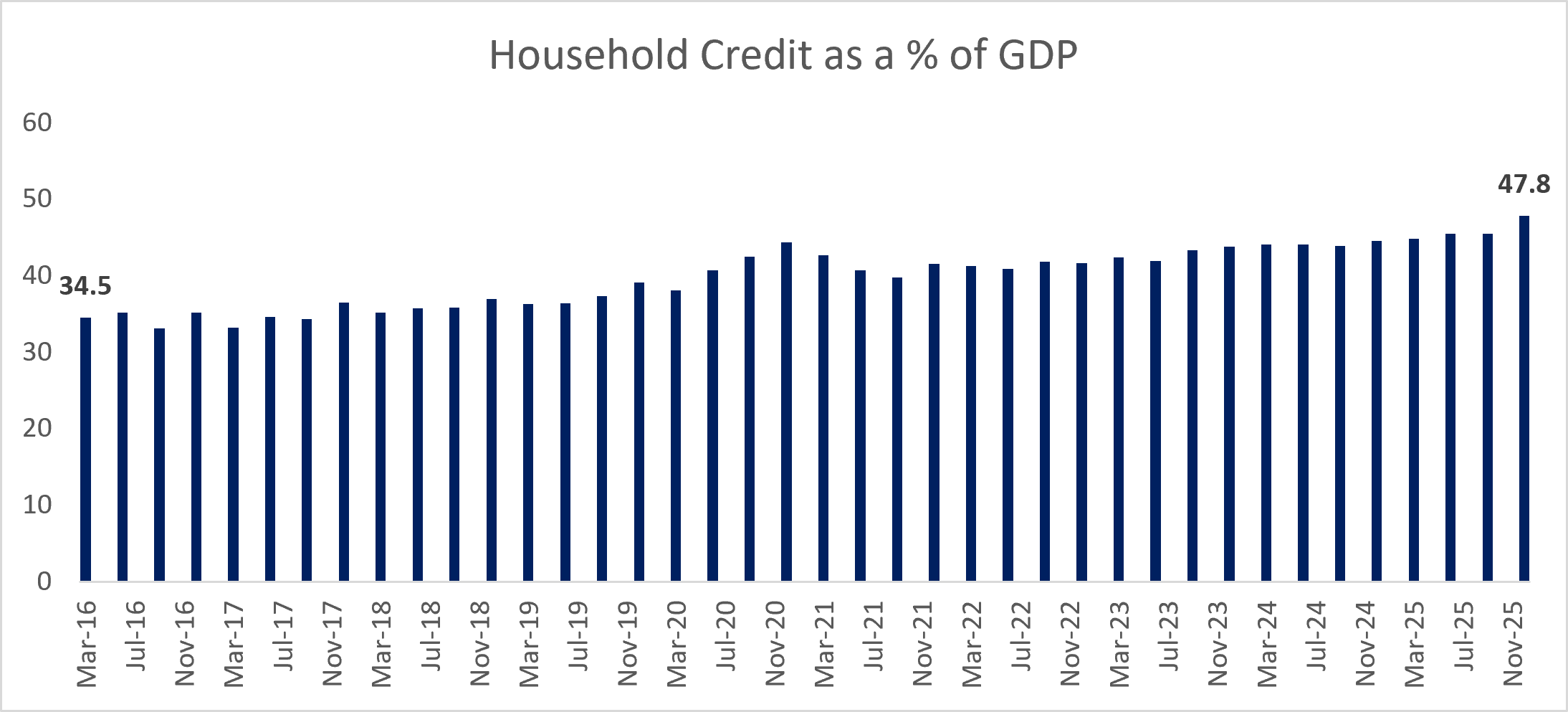
Source: RBI – Financial Stability report, June 26.
The COVID-19 period marked an important turning point. While economic activity slowed initially, accommodative monetary policy lowered borrowing costs. Once restrictions eased, pent-up demand for housing, automobiles, consumer durables, and discretionary spending contributed to a surge in retail credit growth.
At the same time, banks increasingly shifted their focus toward retail lending. Corporate credit demand remained relatively subdued for several years following the banking sector's clean-up cycle. Retail borrowers, by contrast, offered diversification, better risk distribution, and attractive growth opportunities.
As a result, the banking system gradually transformed from being heavily dependent on corporate lending to one where household credit became an increasingly important driver of growth.
The numbers tell a clear story: India's financial system is becoming deeper, and households are becoming more leveraged than at any previous point in modern India's economic history.
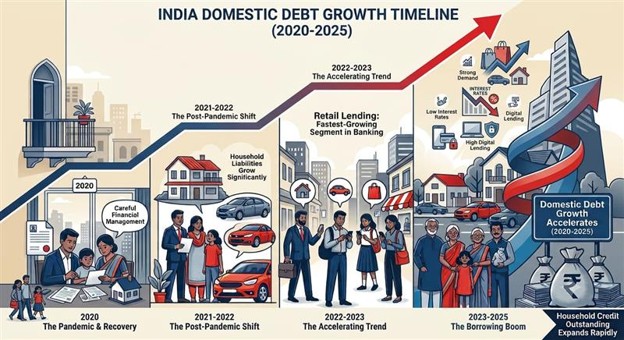
Image for illustration purposes only
What Are Indians Borrowing For?
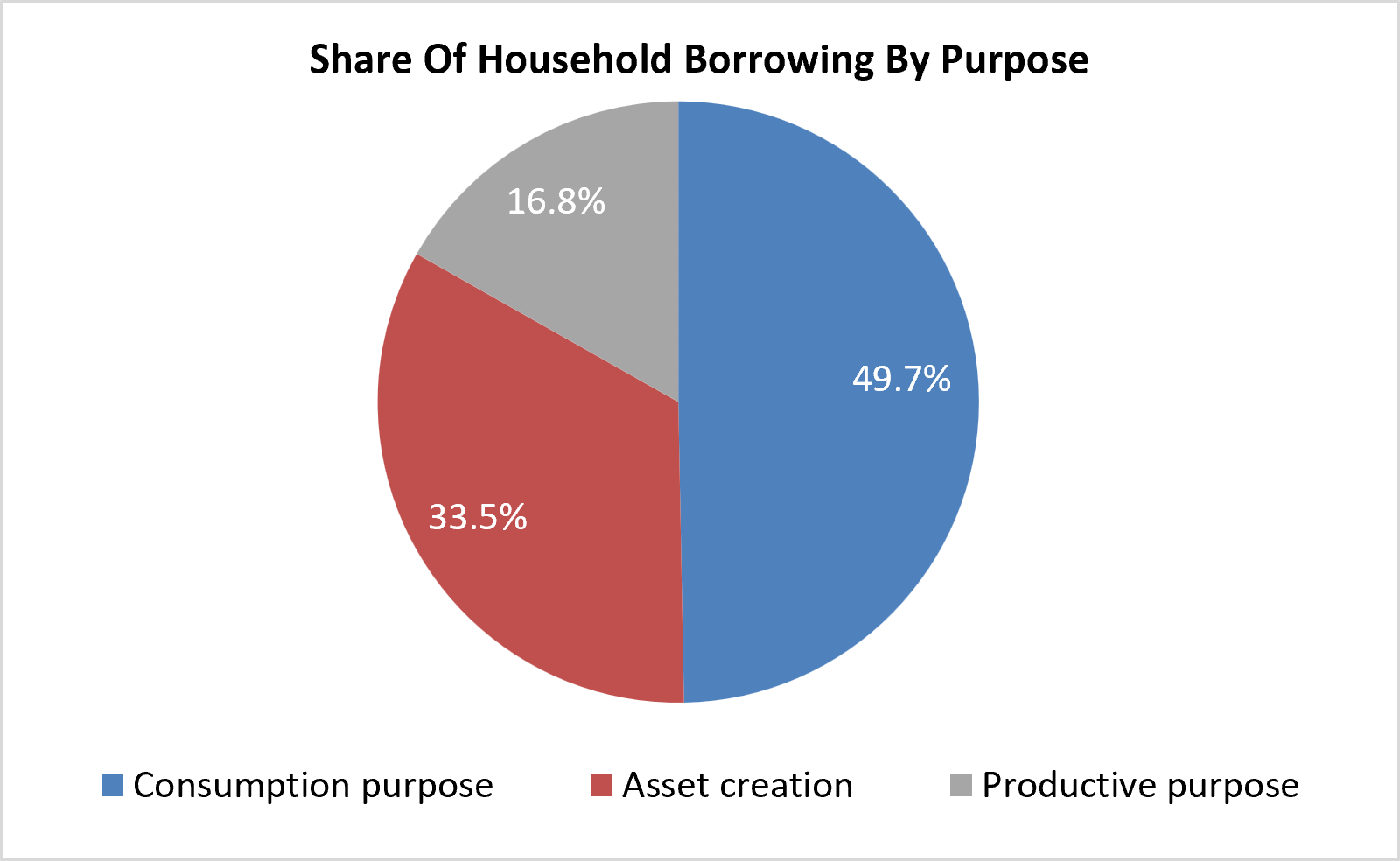
Source: RBI – Financial Stability report, June 26.
The composition of household borrowing is as important as the overall level of debt. Indian households borrow for housing, vehicles, education, consumer durables, personal expenses, gold purchases, and credit card spending. A mix of borrowing offers a deeper view of household financial health than debt levels alone.
Recent years, however, have seen rapid growth in unsecured credit categories such as personal loans and credit card debt. While these products offer convenience and financial flexibility, they are often linked to consumption rather than asset creation and can be more vulnerable to income or employment shocks. A household taking a mortgage to buy a home typically carries a different risk profile from one relying heavily on credit cards for discretionary spending. As a result, the evolution of India's credit mix matters as much as the growth in household borrowing itself.
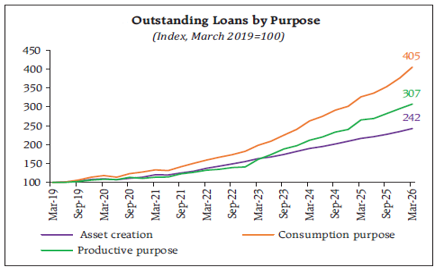
Source: RBI – Financial Stability report, June 26. (https://www.rbi.org.in/Scripts/FsReports.aspx)
Why Are Indians Borrowing More?
India's rising household debt reflects a rapidly evolving economy where greater financial access, urbanization, and rising aspirations are encouraging households to use credit to achieve life goals sooner rather than later.
Financial Deepening: Credit Reaches Millions More - A decade ago, access to formal credit was limited for many Indians. Today, thanks to Aadhaar, UPI, Jan Dhan accounts, digital KYC, and credit bureaus, obtaining a loan has become faster and easier than ever. Credit is no longer confined to a small segment of society; it is now reaching households across urban and rural India.
Aspirations Are Growing Faster Than Savings - India's young and ambitious workforce is increasingly willing to borrow to improve its quality of life. Whether it's buying a home, pursuing higher education, or upgrading living standards, many households are choosing to achieve their aspirations today rather than waiting years to accumulate savings. In a rapidly growing economy, future income expectations often encourage people to spend ahead of earnings.
The Urban Dream Comes with a Price Tag - As India urbanizes, the cost of achieving key life milestones rises. Buying a home, furnishing an apartment, owning a vehicle, or funding quality education often requires financial support. With more Indians moving to cities and urbanization expected to increase significantly over the coming decades, demand for housing and consumer credit continues to rise.
Credit Is Now Just a Click Away -The lending landscape has expanded far beyond traditional banks. NBFCs, housing finance companies, fintechs, and digital lending platforms have made credit available at unprecedented speed and scale. What once took weeks of paperwork can now be completed within minutes on a mobile phone.
Low Interest Rates Encouraged Borrowing - The period between 2020 and 2022 provided an additional boost to debt growth. Lower borrowing costs reduced EMIs, making home loans and other forms of credit more affordable. For many households, this created an opportunity to make large purchases that may have otherwise been postponed.
A Cultural Shift Toward Borrowing - Perhaps the biggest change is behavioral. Borrowing is increasingly viewed not as a sign of financial stress but as a practical way to build assets and improve living standards. As access to credit expands and repayment through EMIs becomes routine, debt has become a more accepted part of household financial planning.
Taken together, these forces have fundamentally changed how Indian households finance consumption and wealth creation. As a result, household debt has been rising faster than Gross National Income, a trend that reflects both the growing opportunities and evolving financial behavior of a rapidly developing economy.
How India Compares Globally
Rising household debt often raises concerns, but international comparisons provide an important perspective.
Despite the rapid growth in borrowing over the past decade, India's household debt remains moderate relative to many developed economies. Household debt stands at roughly 45.5% of GDP in India, compared with approximately 71% in the United States, ~81% in the United Kingdom, 67% in Germany and 67% in Japan. Several other advanced economies, including Canada (~103%), the Netherlands (~97%), Switzerland(~128%), and South Korea(~93%), also maintain substantially higher levels of household leverage. (Data for India is as of Jun 2026- Source- RBI, for other countries it is Dec 2024, Source IMF, https://www.imf.org/external/datamapper/HH_ALL@GDD/SWE)
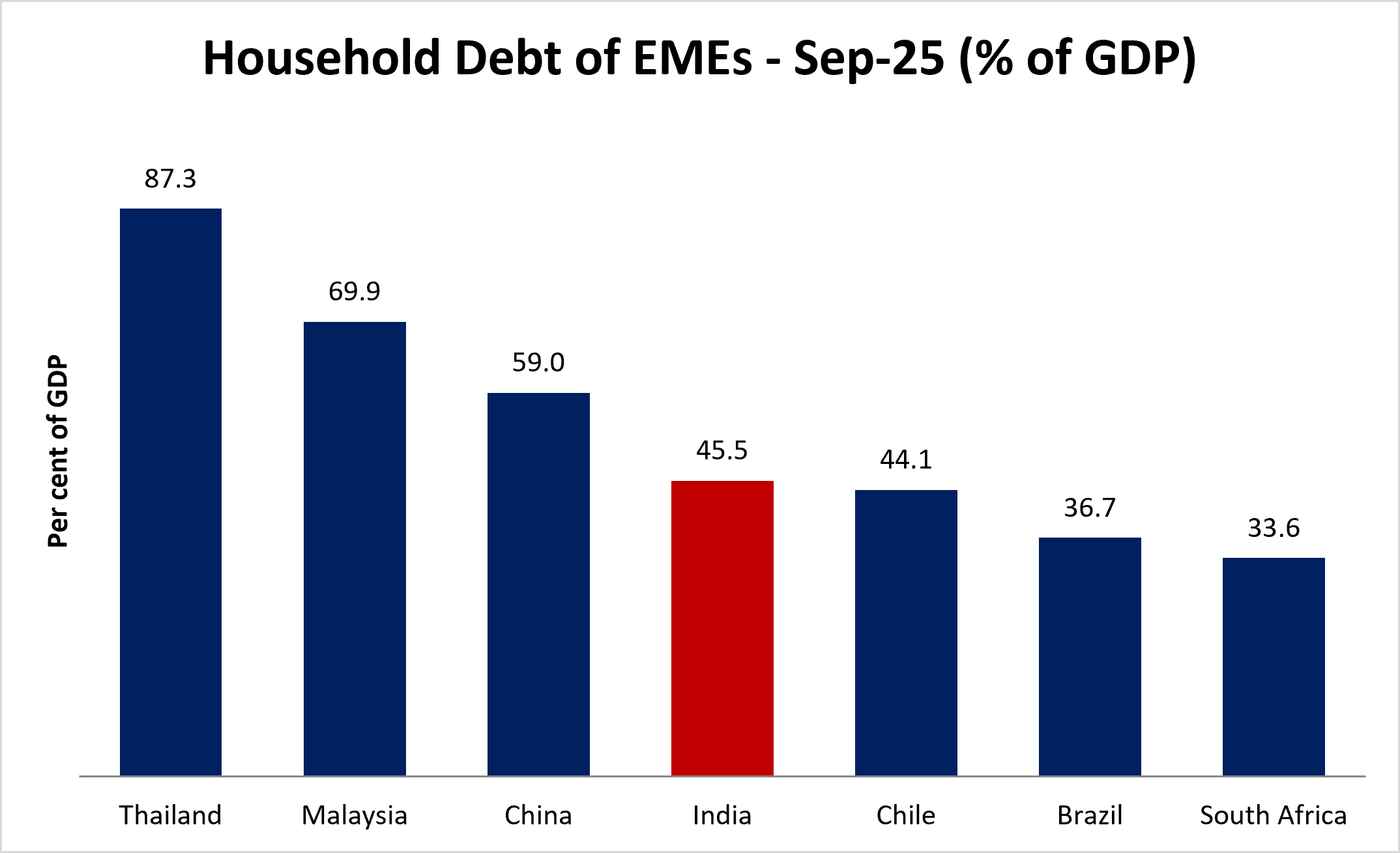
Source: RBI, Financial Stability report, June 26. (https://www.rbi.org.in/Scripts/FsReports.aspx)
Why does India remain comparatively less leveraged?
India remains less leveraged than many developed economies due to lower mortgage penetration, a long-standing preference for savings and physical assets such as gold and real estate, and the availability of family-based financial support. Informal funding and intergenerational wealth transfers often reduce the need for formal borrowing. Additionally, limited access to formal credit in the past kept household leverage relatively low. As financial inclusion expands and credit access improves, household debt is naturally rising from a low base. As a result, India's debt profile should be viewed in the context of a still-evolving financial system rather than compared directly with highly leveraged developed economies.
Debt and Economic Growth
Debt often carries negative connotations, but it plays an essential role in modern economies.
At its core, borrowing is future income brought into the present.
When households borrow, they increase current spending. That spending supports:
- Consumption
- Housing construction
- Manufacturing activity
- Retail demand
- Employment generation
A mortgage stimulates construction, building materials, home furnishings, financial services, and associated economic activity.
Similarly, vehicle financing supports automobile production, logistics, and retail networks.
In this sense, debt can amplify economic growth by enabling households to smooth consumption over their lifetimes and invest in durable assets that improve future welfare.
Debt can support economic growth, but only when it is backed by rising incomes and repayment capacity. In India, domestic debt has grown faster than Gross National Income over the past decade, with average growth of 13.8% versus 10.3% for income. While this reflects increasing financial deepening and access to credit, sustained growth in debt ahead of income warrants monitoring. The key takeaway is that debt can be a positive enabler of growth, provided income growth keeps pace over the long term.
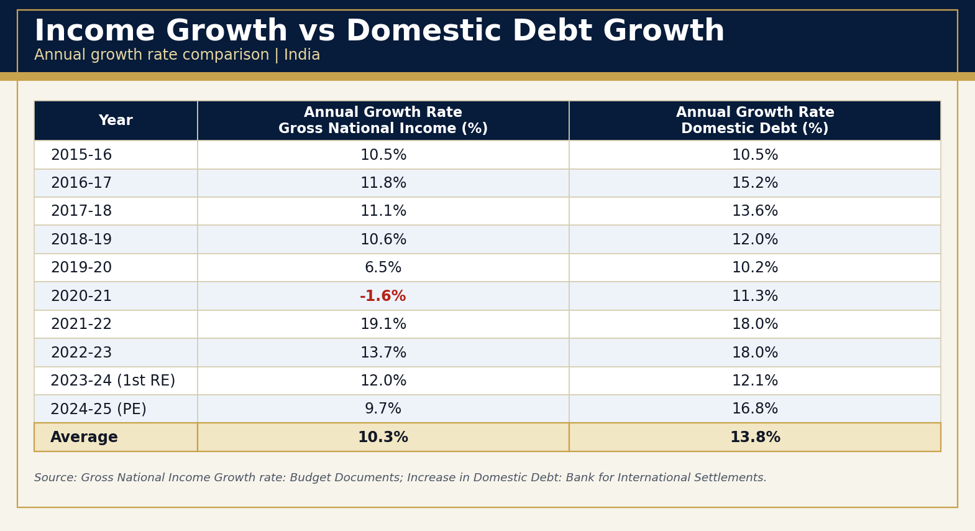
Source links: Budget Documents: https://www.indiabudget.gov.in/economicsurvey/doc/stat/tab1.2.pdf ; BIS: https://data.bis.org/topics/
The risks depend less on the amount of debt and more on borrowers' ability to service it. Key factors to watch are debt-servicing capacity, employment and wage growth, interest rates, and whether borrowing is backed by productive or appreciating assets. A deterioration in any of these could increase financial vulnerability and repayment stress. Perhaps the most important area of focus today is the rapid expansion of unsecured personal loans and credit card debt. Unlike mortgages, these products lack collateral and often carry higher interest rates. They can grow quickly during favorable economic conditions but may become vulnerable during periods of slower income growth.
Conclusion: India's Borrowing Revolution
India's rising household debt is not merely a story of higher borrowing it is a reflection of a changing economy. Greater financial inclusion, rising aspirations, easier access to credit, and growing incomes have brought millions of households into the formal financial system.
Debt, in itself, is neither good nor bad. Its impact depends on what it finances and whether income growth keeps pace with repayment obligations. Borrowing that supports homeownership, education, entrepreneurship, and asset creation can strengthen long-term economic growth; borrowing that outpaces income growth can eventually become a constraint.
For now, India's household debt remains moderate by global standards, but the trajectory bears watching. The key question is not how much Indians are borrowing today, but whether future incomes can support rising financial obligations.
The next phase of India's growth story may therefore be shaped not only by GDP growth or policy reforms, but by a quieter metric: the balance between household aspirations, borrowing, and the ability to repay.
Shibani Kurian, Senior Executive Vice President - Equity Research at Kotak AMC adds "India’s household balance sheet is evolving as households are becoming more leveraged. This is not necessarily as indication of weaker balance sheets. Credit penetration is rising and savings are showing signs of recovery. As long as borrowing supports asset creation and is accompanied by income growth, it may not indicate financial stress. However, levels of leverage need close monitoring as the economy matures."
Disclaimers:
KMAMC is not guaranteeing/offering/communicating any indicative yield/returns on investments. The stocks/sectors mentioned in this slide do not constitute any recommendation and Kotak Mahindra Mutual Fund may or may not have any future position in these sectors/stocks. Companies mentioned don’t constitute recommendation, brand name affiliation disclaimer & companies mentioned for illustrative purpose only. Use of the company brand names does not imply any affiliation with or endorsement by them or any of its holding companies, subsidiaries or affiliates and are used for illustrative purpose only. These materials are not intended for distribution to or use by any person in any jurisdiction where such distribution would be contrary to local law or regulation. The distribution of this document in certain jurisdictions may be restricted or totally prohibited and accordingly, persons who come into possession of this document are required to inform themselves about, and to observe, any such restrictions.
Mutual Fund investments are subject to market risks, read all scheme related documents carefully.