9 Jul 2026
SEBI Registered Name - Kotak Mahindra Mutual Fund
SEBI Registered Number - MF/038/98/1
Traditionally, space has always been seen as the domain of exploration, satellites and scientific discovery. But as artificial intelligence rapidly reshapes industries, a surprisingly new idea is beginning to gain traction: What if the world’s future data centres are not built on Earth at all, but in space?
In 2026, space is beginning to serve a very different purpose. It may soon become the world’s next digital infrastructure hub. Why would anyone want to launch servers, processors and computing infrastructure hundreds of kilometres above Earth when perfectly functional data centres already exist on the ground?
The answer lies in one word that is increasingly reshaping the modern economy:
Artificial Intelligence.
And the extraordinary infrastructure challenge that comes with it. Earlier this year, Elon Musk sparked widespread discussion after posting on X that:
“The most economically compelling place to put AI will eventually be space”, says Elon Musk, the founder of SpaceX.
The next AI race may no longer be about who builds the smartest algorithm. It may be about who builds enough infrastructure to power those algorithms. And increasingly, Earth is beginning to look crowded.
The Invisible Infrastructure Behind Every AI Query
Artificial intelligence feels intangible. We see chatbots answering questions. Recommendation engines suggesting movies. Apps generating images in seconds. Voice assistants scheduling meetings. But what most people never see is the gigantic physical infrastructure quietly working behind every digital interaction. Every time someone asks ChatGPT a question, streams a show on Netflix, stores files on cloud storage, makes a UPI payment or executes a stock trade, enormous data centres somewhere in the world are processing and storing that information. These facilities are essentially the factories of the digital economy. And demand for them is exploding.
The International Energy Agency estimates that global electricity demand from data centres could more than double by 2030, largely because of AI workloads. AI is driving a surge in data centre electricity demand. To understand the scale, training advanced AI models can consume electricity equivalent to the annual power consumption of thousands of households. And electricity is only one part of the equation. Modern data centres also require enormous amounts of land, cooling infrastructure, fibre networks and water. The world is rapidly approaching a new bottleneck.
Simply put: We are running out of capacity to build the digital infrastructure AI requires.
Why The World Suddenly Needs To Think Beyond Earth
For decades, technology improved because chips became faster and smaller. Today, the constraint is no longer only computing power. It is infrastructure. Hyperscale data centres, the massive facilities operated by companies like Amazon Web Services, Microsoft Corporation’s Azure and Alphabet Inc’s Google Cloud consume enormous quantities of resources.
Here is what a modern large-scale AI data centre typically needs:
| Requirement | Growing Problem |
|---|---|
| Electricity | Power shortage |
| Cooling systems | Extremely high water usage |
| Physical land | Scarcity near major cities |
| Fibre connectivity | Infrastructure constraints |
| Permissions | Environmental pushback |
And this is exactly where orbital data centres begin sounding less absurd.
Instead of building larger server farms on Earth, future computing infrastructure could simply orbit the planet itself.
So What Exactly Is An Orbital Data Centre?
At its core, an orbital data centre is remarkably similar to a normal one. It contains servers, GPUs, storage systems and networking hardware.
The only difference? Location.
Instead of sitting in industrial zones in Texas, Singapore or Frankfurt, these systems would orbit Earth, continuously processing data in space. Think of it as cloud computing literally inside the clouds above Earth. The concept is gaining attention because space solves several infrastructure challenges that Earth increasingly struggles with.
| Traditional Data Centres | Orbital Data Centres |
|---|---|
| Depend on local power grids | Powered by near-continuous solar energy |
| Require water cooling | Use radiative cooling |
| Occupy large physical land | No land constraints |
| Face environmental opposition | Operate off-Earth |
| Limited energy scalability | Potentially unlimited solar capture |
The Biggest Advantage Is Energy And Space Has Plenty Of It
Perhaps the strongest argument for orbital computing is power generation. Solar panels on Earth are surprisingly inefficient. They face clouds. Night-time interruptions. Seasonal weather patterns.
Satellites in orbit experience something entirely different. In Sun Synchronous Orbit, satellites receive sunlight almost continuously. This creates access to uninterrupted renewable energy generation on a scale Earth-based systems struggle to replicate. And for AI systems consuming enormous electricity, this matters enormously.
The Cooling Problem That Makes Everything More Complicated
But here comes the paradox. People naturally assume computers should cool easily in space because space is cold. Physics says otherwise. On Earth, data centres remove heat through air conditioning or liquid cooling. These systems depend heavily on convection transferring heat through air or liquids. Space has no atmosphere, no air, no wind and no convection. Heat can escape only through radiation. This means future orbital data centres would need massive radiator systems.
How cooling works
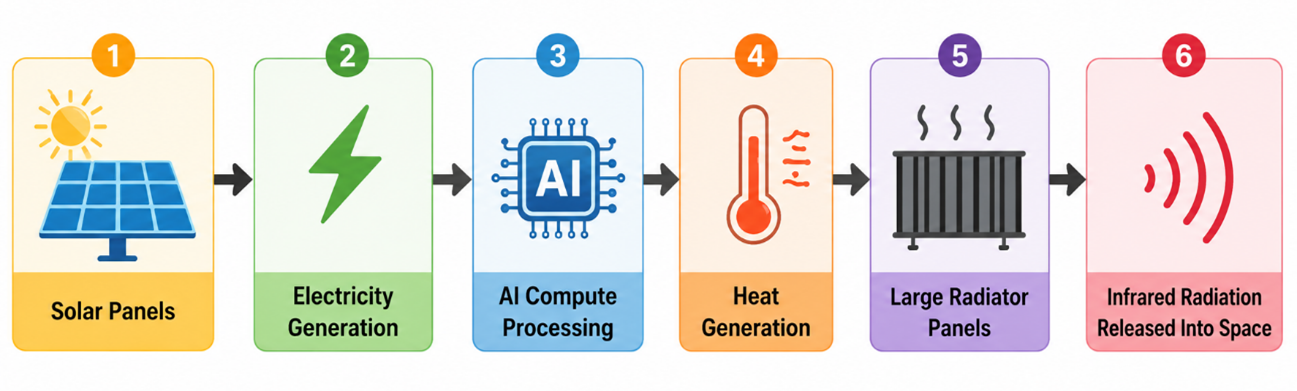
Source: Redwire Corporation Orbital Computing White Paper (2026)
Some researchers estimate cooling systems may require millions of square feet of radiator surfaces for large-scale orbital facilities.
Why This Suddenly Became Economically Possible
For decades, this entire idea was impossible because launching anything into space was prohibitively expensive. Twenty years ago, launch costs often exceeded $20,000 per kilogram. Then SpaceX changed the economics. Reusable rockets dramatically lowered launch costs. Today, some industry estimates suggest costs may eventually fall below $200 per kilogram by the mid-2030s. Reusable rockets are changing launch economics and helping to reduce launch cost per kilogram over time. And this could change everything.
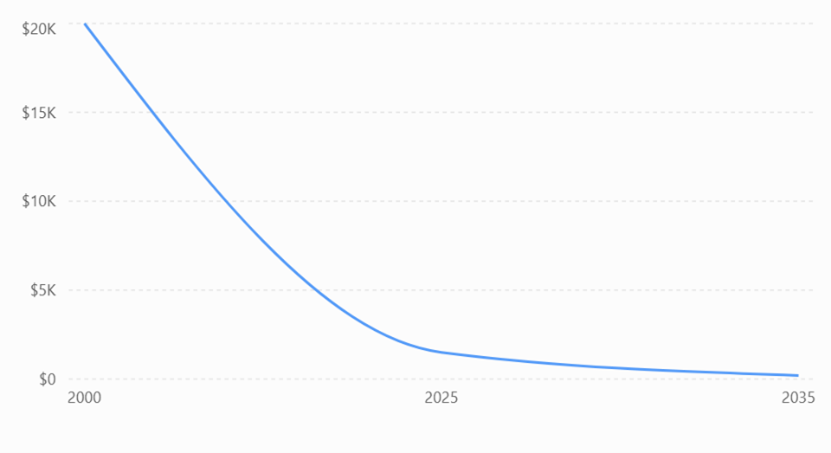
Source: Aerospace market estimates, launch cost studies
The Billionaire Space Race Nobody Is Watching
The orbital computing race has quietly begun. Several major companies are already experimenting.
| Company | Orbital Computing Initiative |
|---|---|
| SpaceX | Large-scale AI satellite infrastructure |
| Project Suncatcher | |
| Blue Origin | Project Sunrise |
| Starcloud | GPU testing in orbit |
| Orbital Compute | Build the first commercial AI cloud in space |
Proposed Orbit Computing Satellite Constellations
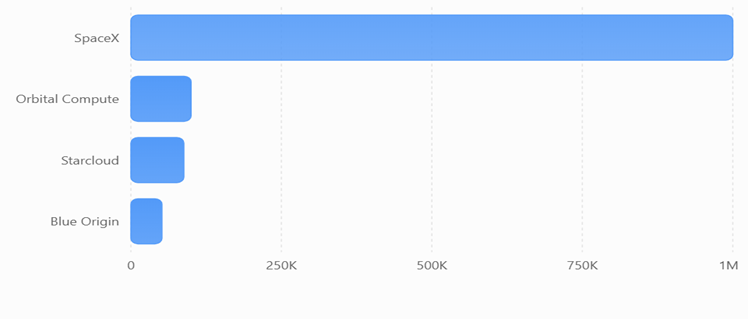
Source: Aerospace America
If realised, more than 1.2 million new objects could enter orbit. However, the Cost Problem Still Has Not Been Solved. Despite the excitement, orbital infrastructure remains expensive.
According to modelling by Novaspace:
| Cost Component | Earth-Based Data Centre | Orbital Data Centre |
|---|---|---|
| Infrastructure | High | Moderate |
| Launch Costs | None | Extremely High |
| Satellite Hardware | None | Very High |
| Cooling Systems | Mature | Experimental |
| Energy Costs | Ongoing | Potentially Lower |
The estimated five-year operational cost comparison tells the story.
| Project Type | Estimated Cost |
|---|---|
| 1 GW Earth-based facility | $17 Billion |
| 1 GW Orbital facility | $46 Billion |
Orbital computing simply isn’t economically competitive today. But falling launch costs could gradually change that equation.
Why Investors Should Pay Attention Even If This Takes Decades
This story is bigger than space. It reflects a far larger trend. Artificial intelligence is forcing the world to rethink infrastructure itself. The companies likely to benefit from this transition extend far beyond space startups.
Potential beneficiaries include:
- Semiconductor companies building AI GPUs like NVIDIA
- Satellite infrastructure firms
- Aerospace manufacturers
- Cloud computing companies
- Renewable energy technology providers
- Robotics and autonomous maintenance systems
In many ways, orbital data centres are simply an extension of one larger reality:
The future AI boom will be constrained not by software innovation, but by physical infrastructure.
Science Fiction Or The Next Industrial Revolution?
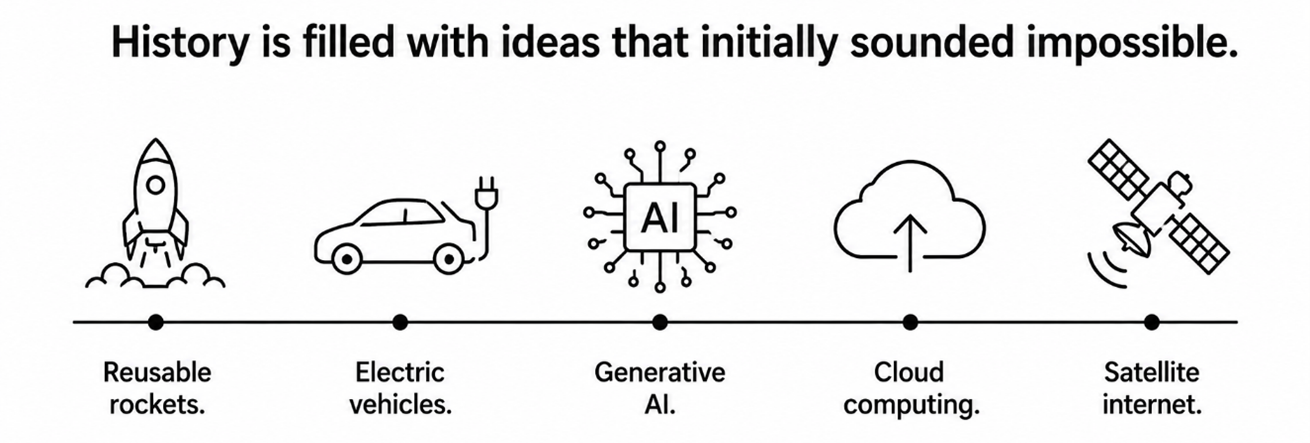
Each began as an ambitious experiment before becoming mainstream. Orbital data centres may eventually join that list. Or they may remain too expensive and technically complex to ever scale commercially. But the fact that companies worth hundreds of billions of dollars are seriously discussing it tells us something important. The AI revolution is no longer just transforming software. It is beginning to reshape the physical architecture of the global economy itself. For centuries, human progress depended on building roads, ports, factories and power plants on Earth. For the first time in history, critical infrastructure may begin expanding beyond the planet itself. The next great infrastructure race may not be about who builds the biggest data centre in California, Singapore or Mumbai. It may be about who builds the first one among the stars. And humanity may soon discover that the future of computing is not sitting inside a warehouse on Earth. It is orbiting quietly above our heads.
Sudheer Guntupalli, Vice President- Equity Research adds, “As artificial intelligence rapidly reshapes the global economy, the world is confronting a new bottleneck - not computing power, but physical infrastructure. Modern data centres consume enormous electricity, land, water and cooling capacity, with the IEA projecting global data centre power demand to more than double by 2030, largely driven by AI workloads. Earth is running out of room, grid capacity and environmental tolerance. Enter orbital data centres - servers orbiting the planet, powered by near-continuous solar energy in Sun Synchronous Orbit and cooled radiatively, unconstrained by land or water. SpaceX, Google's Project Suncatcher, Blue Origin's Project Sunrise and Starcloud have already entered the race. Reusable rockets have slashed launch costs from $20,000/kg two decades ago toward under $200/kg by the mid-2030s. Economics still favour Earth today (opex cost of $17bn vs $46bn for a 1 GW facility over 5 years), but the AI revolution may soon reshape infrastructure itself - beyond our planet."
Disclaimers
Use of the company/ brand names does not imply any affiliation with or endorsement by them or any of its holding companies, subsidiaries or affiliates and are used for illustrative purpose only. The stocks/sectors mentioned do not constitute any kind of recommendation and are for information purpose only. Kotak Mahindra Mutual Fund may or may not hold position in the mentioned stock(s)/sector(s). These materials are not intended for distribution to or use by any person in any jurisdiction where such distribution would be contrary to local law or regulation. The distribution of this document in certain jurisdictions may be restricted or totally prohibited and accordingly, persons who come into possession of this document are required to inform themselves about, and to observe, any such restrictions
Mutual Fund investments are subject to market risks, read all scheme related documents carefully.