16 Jul 2026
SEBI Registered Name - Kotak Mahindra Mutual Fund
SEBI Registered Number - MF/038/98/1
In 2024, people around the world weren't just discussing who would win the U.S. presidential election, they were trading on its outcome. Not stocks. Not currencies. Not bonds.
Instead, they were buying and selling contracts linked to a simple question: Who will win the election?
All of this activity took place on prediction markets, platforms where people buy and sell contracts tied to the outcomes of future events. These events can range from elections and sporting tournaments to inflation readings, interest-rate decisions, and corporate earnings announcements.
Unlike traditional financial assets, the value of these contracts depends entirely on whether a specific event occurs. What makes prediction markets particularly interesting is that their prices serve as real time forecasts. As participants buy and sell contracts based on their expectations, the market continuously incorporates new information and converts collective opinion into a measurable probability.
In a typical prediction market, a contract trading at 60 cents implied that the market assigned roughly a 60% chance to that event happening. As confidence increased, the price moved higher. As expectations weakened, it moved lower.
Disclaimer: The above example is for understanding and illustrative purposes
Prediction has fascinated humans for centuries. In 1906, British polymath Francis Galton conducted an experiment at a country fair where nearly 800 people were asked to guess the weight of an ox. Individual estimates varied widely, and Galton expected the exercise to show why forecasting should be left to experts. Instead, when he calculated the average of all the guesses, the crowd's estimate turned out to be remarkably accurate; within 1% of the ox's actual weight. The experiment revealed a powerful idea: under the right conditions, a diverse group of independent individuals can collectively make better judgments than any single expert. This concept, later known as the Wisdom of Crowds, has gone on to influence fields ranging from economics and political science to artificial intelligence and decision-making.
Source: Published work of Francis Galton from (1907)
Similarly, as thousands of participants continuously buy and sell contracts, prediction markets transform dispersed information into a single probability that evolves in real time.
Although prediction markets have attracted widespread attention only in recent years, their origins date back several decades. Modern prediction markets gained academic prominence with the launch of the Iowa Electronic Markets (IEM) in 1988. Developed by researchers at the University of Iowa, IEM was originally designed as an experiment to determine whether financial markets could forecast election outcomes more accurately than traditional opinion polls. The results were remarkable.
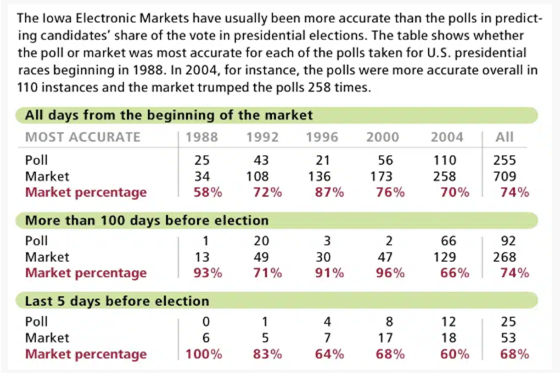
Source: March 2008 article in Scientific American
Over time, prediction markets expanded far beyond politics. They are now used to forecast monetary policy decisions, inflation, corporate earnings, scientific discoveries, sporting events, weather outcomes, and technological innovation.
Today, platforms such as Kalshi, Polymarket, PredictIt, etc. allow participants to trade on thousands of real-world events. While some operate within regulated financial frameworks, others rely on alternative models such as blockchain-based infrastructure, research exemptions, or virtual-currency systems. Such prediction market platforms are not currently permitted to operate in India, and participation in offshore event-based prediction markets is disallowed under the prevailing Indian regulatory framework.
Source:https://www.sebi.gov.in/media-and-notifications/press-releases/apr-2025/caution-to-public-against-dealing-on-opinion-trading-platforms-_93708.html
The growth of the industry has been equally remarkable. Monthly trading volume, which hovered around USD 1.2 billion in 2025, began to accelerate sharply in September 2025, entering a new regime of sustained double-digit billions. By early 2026, volumes exceeded USD 20 billion per month, with more than 800,000 unique wallets participating each month.
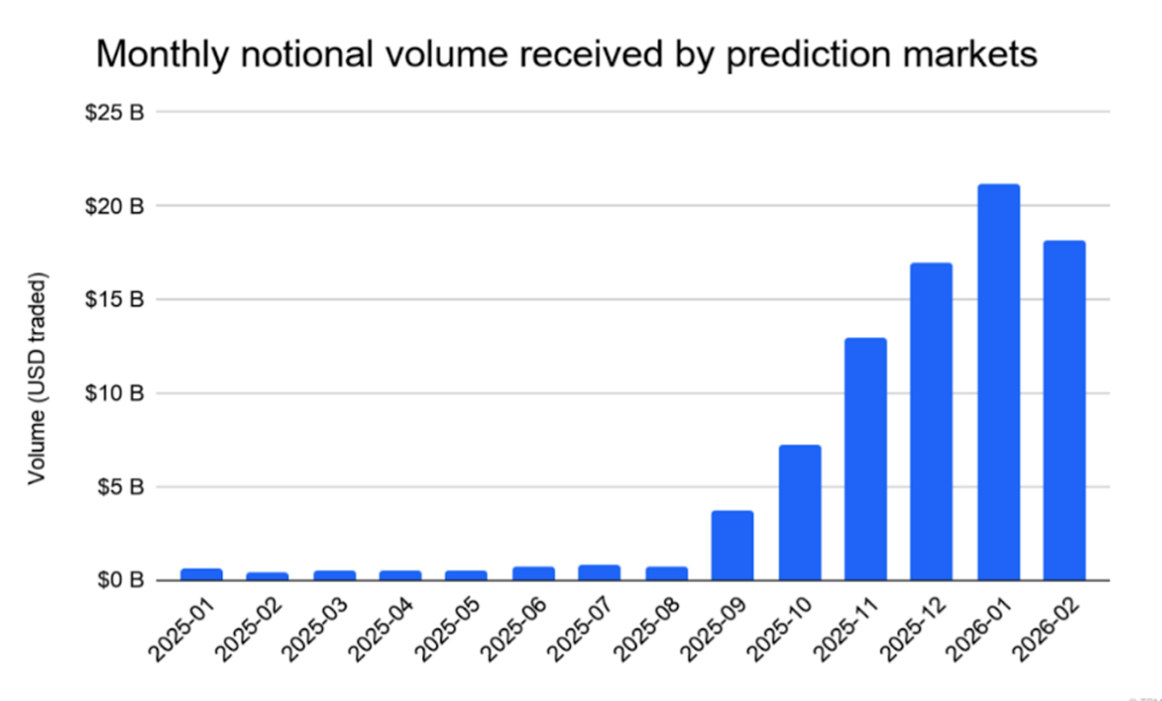
Source: TRMlabs.com as of March 27, 2026
In fact, prediction markets have taken bets worth close to $2bn on which country will win the World Cup, putting them on course to potentially break the record for the biggest market in history more than 5 weeks before the final.
Macquarie estimates that World Cup-related bets across all gambling venues could exceed $50bn this year, a 43 per cent increase on the amount wagered on the 2022 World Cup in Qatar.
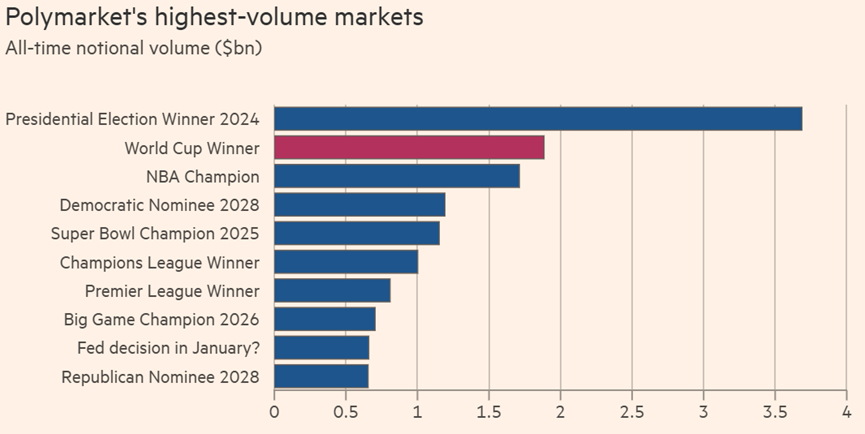
Source: Financial Times article dated June 11, 2026
In fact, Bernstein estimates that total market volumes in 2026 will reach $240 billion, a 370% increase compared to last year. At a compound annual growth rate of roughly 80% between 2025 and 2030, sees prediction market trading volume of $1 trillion a year by the start of the next decade.
Source: CNBC article dated 14 April, 2026
How Prediction Markets Work
The mechanics of prediction markets are best understood through a practical example.
Consider one of the most closely watched events in global financial markets - the U.S. Federal Reserve's monetary policy decision. Changes in interest rates influence borrowing costs, bond yields, equity valuations, exchange rates, and capital flows worldwide. Consequently, investors continuously reassess the likelihood of future policy actions as new economic information becomes available.
In early June, strong inflation and resilient economic data lead markets to assign only a 32% probability of a September Federal Reserve rate cut, with the YES contract trading at $0.32. As inflation eases, growth slows, and policymakers adopt a more accommodative tone, expectations strengthen and the contract rises to $0.87, implying an 87% probability. An investor buying 100 YES contracts at $0.32 invests $32. If the Federal Reserve cuts rates, the contracts settle at $1, generating a $68 profit. If no rate cut occurs, the investment is lost.
This illustrates how prediction markets continuously incorporate new information into prices, providing a real-time estimate of the probability of future events rather than a fixed forecast.
The ability of these markets to update probabilities in real time is not accidental. It is the result of trading mechanisms designed to efficiently aggregate information from many participants.
Behind their apparent simplicity, prediction markets rely on sophisticated market structures that enable efficient trading.
Many platforms operate using a Continuous Double Auction (CDA), similar to stock exchanges, where buyers submit bids and sellers submit offers. Transactions occur whenever both sides agree on a price. Other platforms employ Automated Market Makers (AMMs). Instead of relying entirely on buyers and sellers, mathematical algorithms continuously quote prices and provide liquidity, ensuring that participants can trade even when counterparties are limited.
While these trading mechanisms make it possible to continuously aggregate information and update probabilities in real time, they do not guarantee perfect forecasts. Like any market, prediction markets have strengths that make them powerful forecasting tools, but they also face practical limitations that can affect their accuracy and efficiency.
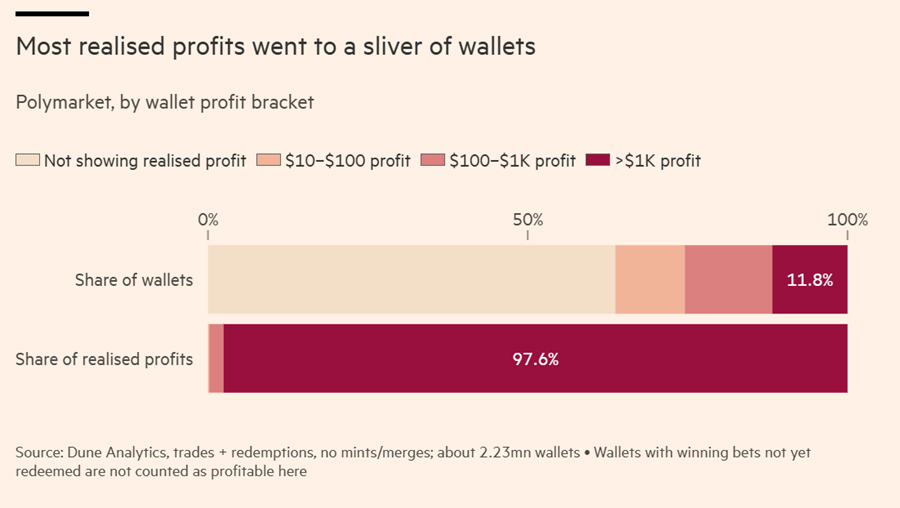
Low liquidity can reduce pricing efficiency, speculative trading may temporarily distort probabilities, and regulatory uncertainty remains an important challenge across different jurisdictions. Additionally, the highest profits on the platform are concentrated among a few users. Keyrock, a market maker that tracks the sector, said that $15.2bn in profits — more than two-thirds of all money won on Polymarket — was held by just 740 accounts — a tiny fragment of the more than 2mn trading on the platform.
Dune, a crypto data platform, found that 58% of user wallets on Polymarket were in the red.
Source: Financial Times article dated Apr 3, 2026
Despite their growing popularity globally, Prediction markets currently do not form part of the mainstream regulated investment ecosystem in India and may be subject to legal and regulatory considerations. Investors should independently understand applicable laws and regulations. Platforms that allow participants to trade contracts linked to future events are generally viewed through the lens of gambling and wagering regulations, leaving little room for the development of a formal prediction-market ecosystem. Globally, however, prediction markets continue to gain momentum. Trading volumes have grown rapidly in recent years, driven by interest in elections, monetary policy decisions, sporting events, and technological developments. The growing interest is evident from reports that Meta is developing a standalone prediction platform called "Arena," aimed at allowing users to forecast future events using a points-based system rather than real-money trading.
Advances in artificial intelligence, blockchain technology, digital trading infrastructure, and automated market-making are transforming prediction markets into increasingly sophisticated forecasting tools. Rather than replacing traditional forecasting methods, prediction markets are emerging as powerful complements to expert analysis and statistical models. Artificial intelligence excels at analysing historical data, while prediction markets capture human expectations and incorporate new information as events unfold. Some commentators suggest that combining AI-driven analysis with market-based forecasting may improve forecasting processes, although outcomes can vary and no accuracy enhancement is guaranteed.
Nilesh Shah, Managing Director, Kotak Mahindra AMC, “Human beings have always been curious about the future. Farmers looked at the clouds, traders watched market prices and economists studied data to understand what may happen next. Prediction markets add a new dimension to this process. By combining the views of a large number of participants, they transform opinions into probabilities. The outcome may not always be correct, but the process offers valuable insight into how information is absorbed and interpreted. As technology improves our ability to process information, it will be interesting to see how collective wisdom shapes the future of forecasting.”
Use of the company/ brand names does not imply any affiliation with or endorsement by them or any of its holding companies, subsidiaries or affiliates and are used for illustrative purpose only. The stocks/sectors mentioned do not constitute any kind of recommendation and are for information purpose only. Kotak Mahindra Mutual Fund may or may not hold position in the mentioned stock(s)/sector(s). These materials are not intended for distribution to or use by any person in any jurisdiction where such distribution would be contrary to local law or regulation. The distribution of this document in certain jurisdictions may be restricted or totally prohibited and accordingly, persons who come into possession of this document are required to inform themselves about, and to observe, any such restrictions.
Prediction markets are an emerging global phenomenon discussed for educational purposes only. They are distinct from regulated mutual fund investments and may be subject to legal, regulatory or wagering-related restrictions in various jurisdictions.
This article is intended solely for investor education and informational purposes. It should not be construed as investment advice, a recommendation, solicitation, endorsement or promotion of any prediction market platform, contract, product or strategy."
Mutual Fund investments are subject to market risks, read all scheme related documents carefully.