20 Aug 2026
SEBI Registered Name - Kotak Mahindra Mutual Fund
SEBI Registered Number - MF/038/98/1
For years, the world has focused on oil shortages, financial crises, trade disputes, and technological disruption. Yet one of the biggest threats to future growth and stability may come from something far more basic: water.
Most people rarely think about water beyond turning on a tap. But water sits at the heart of modern life. It grows our food, powers industries, generates energy, supports public health, and drives economic development. Without reliable access to water, cities struggle, businesses slow down, and communities become vulnerable.
As the global population exceeds 8+ billion and climate change disrupts rainfall patterns, the gap between water demand and supply is widening.
A Global Crisis Hiding in Plain Sight
Water insecurity rarely makes headlines until a crisis erupts. Unlike earthquakes or financial crashes, it develops slowly. Reservoirs shrink, groundwater levels fall, rivers become polluted, and droughts become more frequent. By the time the warning signs become visible, the problem is often much larger than expected.
The scale of the challenge is staggering. Nearly 4 billion people across Asia and the Pacific face some level of water insecurity. Yet the issue is not simply about scarcity. Many regions now swing between devastating floods and severe droughts, making water availability increasingly unpredictable.
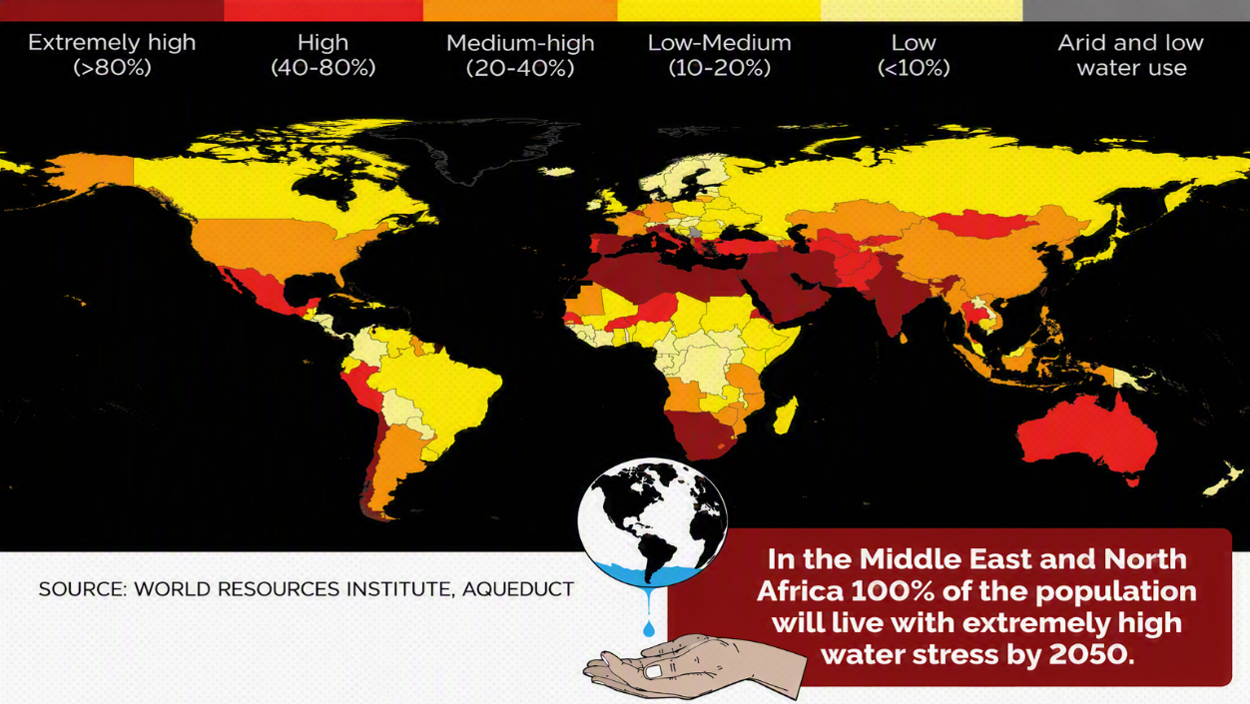
Where the water stress would be highest by 2050
By 2050 Global water demand is projected to increase by 20% to 25% and an additional 1 billion people are expected to live with extreme high-water stress
Source: Census.gov, World resources institute, Aqueduct, network 18, Asian Development Bank
Why Water Security Matters to Everyone
Water is far more than a basic utility. It is the foundation of modern life and economic growth. Almost everything we use every day depends on it. The food on our plates, the electricity in our homes, the clothes we wear, and even the medicines we consume all require water at some stage of production.
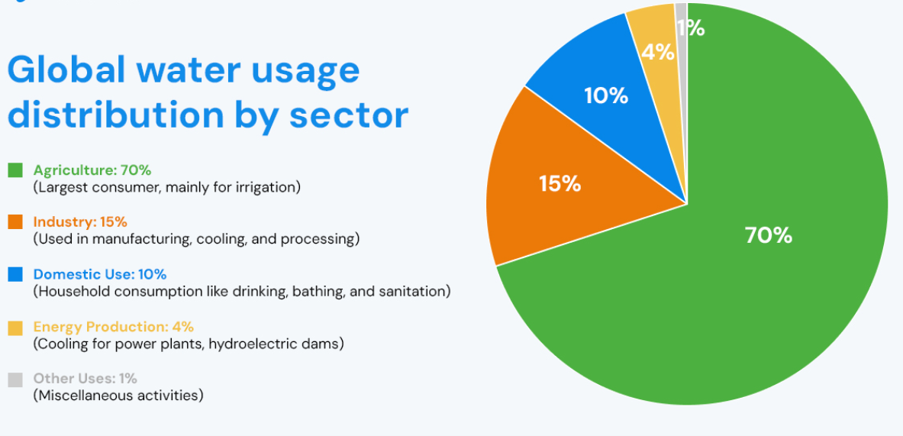
Agriculture remains the world's largest consumer of freshwater, while industries such as textiles, chemicals, pharmaceuticals, electronics, and manufacturing depend on reliable water supplies to operate. Even the industries driving the future economy, including data centres, semiconductor manufacturing, electric vehicles, and renewable energy, are heavily dependent on water.
The rapid growth of artificial intelligence is adding another dimension to the challenge. Data centres are estimated to have consumed around 4.5 trillion litres of water in 2025, enough to meet the annual needs of more than 600 million people in Sub-Saharan Africa. This figure could potentially double to around 9.3 trillion litres by 2030 as AI-driven data centre capacity expands.
As populations grow and economies expand, demand for water is rising across households, farms, and industries. This is creating increasing pressure on already stretched resources. The real challenge is no longer about finding new sources of water. It is about managing existing resources more efficiently, sustainably, and intelligently.
Source: flosenso.com, reuters.com, U.N. research
Source: flosenso.com, reuters.com, U.N. research
Climate Change: The Ultimate Water Stress Multiplier
Climate change and water are deeply connected. For decades, communities and governments relied on predictable rainfall, seasonal river flows, and stable weather patterns. Today, that certainty is disappearing.
Rising temperatures are increasing evaporation from rivers, reservoirs, and farmland, while rainfall is becoming more erratic and extreme. Some regions are facing prolonged droughts and water shortages, while others are experiencing devastating floods within short periods. Both situations place enormous pressure on communities, agriculture, and infrastructure.
The challenge goes beyond rainfall. Glaciers that supply freshwater to billions of people are shrinking, and rising sea levels are increasing the risk of saltwater contaminating groundwater reserves in coastal areas.
Water has become the channel through which many climate risks are felt. When water availability becomes unpredictable, food production, energy generation, industries, and local economies all come under stress. As climate change accelerates, managing water effectively will be critical to building resilience and protecting future growth.
Conflicts Over Water Are on the Rise
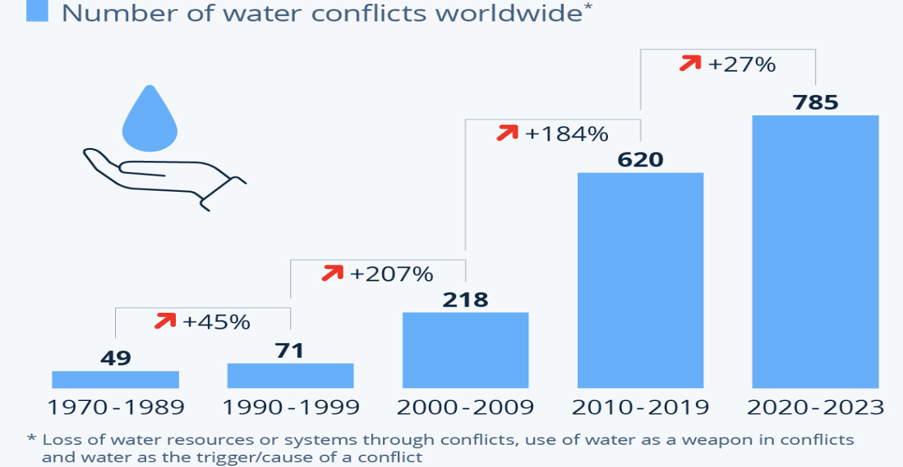
Water scarcity is no longer just an environmental issue. It is increasingly becoming a source of tension and conflict around the world. These conflicts range from attacks on water infrastructure and the use of water as a strategic tool during conflicts to disputes over access and control of scarce water resources. As water becomes more limited, competition inevitably intensifies.
The consequences of water stress extend far beyond reservoirs and rivers. It can disrupt livelihoods, accelerate migration, strain urban infrastructure, and heighten social tensions. Water security is therefore no longer just about conservation. It is about economic stability, social harmony, and sustainable growth. In the decades ahead, a nation's ability to manage water may be as important as its ability to manage energy, infrastructure, or national security.
Source: Statista
India: A Country of Abundance and Scarcity
India's water story is a paradox. The country is blessed with mighty rivers, substantial monsoon rainfall, and a rich agricultural legacy. Yet it faces one of the most severe water security challenges in the world.
The imbalance is striking. India is home to more than 18% of the global population but has access to only about 4% of the world's freshwater resources. As cities expand, industries grow, and living standards improve, demand for water continues to rise across every sector of the economy.
Agriculture consumes around 80% of the country's freshwater resources, while India remains the world's largest user of groundwater. With water demand expected to rise significantly by 2050, efficient water management is no longer just an environmental priority. It is essential for India's economic growth, food security, and long-term development.
Source: NITI Aayog, India Water Resource Information System, downtoearth.org.in
Surface water scarcity
Between 1950 and 2024, India has seen a decline of 73% in per capita surface water availability
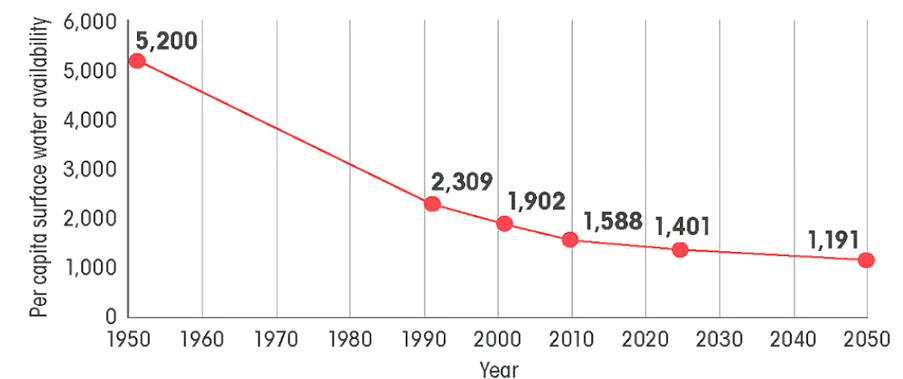
Source: NITI Aayog, India Water Resource Information System, downtoearth.org.in
Agriculture, Cities and Pollution: The Three Fronts of India's Water Challenge
India's water future will largely be decided on farms. The Green Revolution helped the country achieve food security, but it also encouraged the cultivation of water intensive crops such as paddy and sugarcane in regions facing growing water stress. The solution is not to produce less food, but to produce it more efficiently. Technologies such as drip irrigation, precision farming, soil moisture monitoring, and drought resistant crop varieties can help farmers grow more with less water.
At the same time, India's cities are becoming increasingly thirsty. Rapid urbanisation is pushing demand higher, while water infrastructure struggles to keep pace. Major cities such as Bengaluru, Delhi, Chennai, and Hyderabad depend heavily on distant water sources. Leakages, ageing pipelines, and inefficient distribution systems result in significant water losses before water even reaches consumers.
The challenge is not only about quantity but also quality. Across the country, rivers, lakes, and groundwater sources are under pressure from untreated sewage, industrial waste, and agricultural runoff. Every polluted water body reduces the amount of usable freshwater available to society.
The consequences go far beyond the environment. Poor water quality increases healthcare costs, affects livelihoods, lowers productivity, and places additional pressure on already scarce resources. India's water challenge is no longer just about securing more water. It is about using water wisely, delivering it efficiently, and protecting the resources that remain.
Solutions Are Within Reach
The water crisis may be growing, but so are the solutions. Around the world, technology is helping communities use water more efficiently and sustainably. Smart irrigation systems are reducing water use in agriculture, wastewater recycling is creating new sources of supply, and satellite monitoring is improving the management of groundwater resources. Desalination technology is Converting seawater into drinking water is becoming increasingly efficient and cost-effective, especially for coastal regions. Artificial intelligence is also helping predict shortages and optimize water distribution.
Innovation alone, however, will not solve the problem. Equally important are practical measures such as rainwater harvesting, watershed development, wetland restoration, and groundwater recharge. These approaches strengthen resilience while protecting natural ecosystems.
The most successful water strategies combine technology with strong governance, effective policies, institutional coordination, and active public participation. Water security is not the responsibility of governments alone. Businesses, farmers, communities, and individuals all have a role to play.
The challenge is significant, but the path forward is clear. The solutions already exist. What is needed now is the commitment to implement them at scale and with urgency.
The Next Big Infrastructure Opportunity
As water scarcity intensifies, it is creating a significant long-term investment opportunity across the water ecosystem. India may require over ₹20 lakh crore of investment over the next decade to strengthen water supply, treatment, recycling, storage and distribution infrastructure.
Companies engaged in water treatment, wastewater recycling, desalination, smart metering, pumps & pipelines, irrigation technology and industrial water solutions could benefit from this multi-decade structural trend. India's water and wastewater treatment market is projected to grow from around $3 billion in FY25 to $5.2 billion by FY31, while industrial water infrastructure spending is expected to see steady growth supported by stricter environmental norms.
Government spending remains a major catalyst. The Jal Jeevan Mission carries an annual allocation of about ₹67,000 crore, while the Ministry of Jal Shakti has been allocated nearly ₹99,500 crore for FY26. Large programmes such as AMRUT 2.0 and Namami Gange are further driving investments in urban water and wastewater infrastructure.
Sustained public investment, tightening environmental regulations, rising urbanisation and growing industrial water demand position water infrastructure as a long-duration investment theme, offering multi-year growth opportunities for companies across the sector.
Source: Moneycontrol.com, Prabhudas Lilladher
Conclusion
Water is rapidly emerging as one of the defining economic, social and environmental challenges of the 21st century. Rising demand, climate uncertainty and growing urbanisation are placing unprecedented pressure on freshwater resources across the world and particularly in India. Yet this challenge also creates an opportunity. Investments in efficient water management, recycling, storage, treatment and distribution can help bridge the gap between demand and supply. The countries and companies that address water security today will be better positioned for sustainable growth tomorrow. In an increasingly uncertain world, water may prove to be as strategically important as energy.
Mr. Nalin Bhatt, Fund Manager & Senior VP- Equity Research at Kotak Mahindra AMC adds,” Fresh water is emerging as one of the world’s most constrained resources. While water covers nearly 70% of the Earth’s surface, only about 2.5% is freshwater and less than 1% is readily accessible for human use. Population growth, urbanization, climate change, and industrialization are accelerating demand at a time when many river basins and aquifers are already under stress. New-age industries are adding a significant layer of demand. Historically, water has been a low-cost (or No cost!) utility input and thus, there has been no incentive to conserve, completely recycle. This theme can emerge as big opportunity of growth and investment”.
KMAMC is not guaranteeing/offering/communicating any indicative yield/returns on investments. The stocks/sectors mentioned do not constitute any kind of recommendation and are for information purpose only. Kotak Mahindra Mutual Fund may or may not hold position in the mentioned stock(s)/sector(s). Companies mentioned don’t constitute recommendation, brand name affiliation disclaimer & companies mentioned for illustrative purpose only. These materials are not intended for distribution to or use by any person in any jurisdiction where such distribution would be contrary to local law or regulation. The distribution of this document in certain jurisdictions may be restricted or totally prohibited and accordingly, persons who come into possession of this document are required to inform themselves about, and to observe, any such restrictions.
MUTUAL FUND INVESTMENTS ARE SUBJECT TO MARKET RISKS, READ ALL SCHEME RELATED DOCUMENTS CAREFULLY.