31 Jul 2025
Investors often seek diversification to reduce risk, but managing multiple mutual fund schemes across various asset classes can be complex. Multi asset allocation funds offer a structured solution by investing in at least three distinct asset classes typically equity, debt, and gold with a minimum allocation of at least 10% to each asset class, as defined by SEBI. These funds are actively managed to adapt to changing market conditions, with the objective of maintaining a balanced and diversified portfolio. In this article, we will explore multi asset allocation meaning, how they work, their benefits and key risks, and who they may be suitable for.
Key Takeaways
- Multi asset allocation funds invest in at least three asset classes, with a minimum allocation of at least 10 % to each class as per SEBI rules.
- These funds aim to offer diversification, professional rebalancing, and a simplified investment experience.
- The asset mix typically includes equity for growth, debt for relative stability, and a third asset such as gold for hedging.
- Taxation depends on the fund’s underlying equity exposure and holding period; investors should refer to a tax reckoner or consult an advisor.
Multi Asset Allocation Fund Definition
A multi asset allocation fund is a type of mutual fund that invests in at least three different asset classes, such as equity, debt, and gold. As per SEBI regulations, it must allocate a minimum of 10% to each asset class at all times, ensuring diversified exposure and balanced risk. This structure promotes diversification and avoids over concentration in any single market, making it distinct from other hybrid fund categories.
How Multi Asset Allocation Funds Work?
- Multi asset allocation funds are designed to spread investments across multiple asset classes typically equity, debt, and gold with a minimum of 10% invested in each, as mandated by SEBI. This approach aims to build a portfolio that adapts to changing market conditions while maintaining a diversified base.
- These funds are actively managed. Fund managers regularly assess economic trends, market risks, and asset performance to decide how much to allocate to each segment. For instance, if equity valuations appear stretched, the fund may reduce exposure to stocks and shift more into fixed income/debt or gold, which tend to offer relative stability.
- The idea is not to chase short term gains but to create a mix that aligns with the fund’s stated investment objective. By doing so, the fund aims to lower overall volatility and reduce the impact of any single market event on your portfolio.
- This strategy also supports better risk adjusted returns, often measured using the Sharpe ratio a metric that shows how much excess return the fund delivers for the risk it takes. A higher Sharpe ratio generally indicates a more efficient return profile.
Typical Asset Mix
Unlike traditional hybrid funds that invest primarily in a mix of equity and debt, multi asset allocation funds are structured to include three or more distinct asset classes, with a minimum allocation of 10% in each, as mandated by SEBI.
Commonly, these funds diversify across equity for long term growth, debt instruments for relative stability, and a third asset often gold or commodities which helps hedge against inflation and market volatility. If you’re new to the concept of investing in gold through mutual funds, you can learn more from this gold fund basics article.
Some schemes may go a step further and include exposure to international equities or other alternative assets, depending on the investment mandate. The fund manager adjusts the allocation dynamically, within regulatory limits, based on market conditions and macroeconomic factors.
The core idea is to offer broader diversification by combining multiple uncorrelated asset classes within a single fund. This helps reduce reliance on the performance of any one segment and aims to deliver a more balanced investment experience across market cycles.
Benefits & Key Risks in Multi Asset Allocation Fund
Benefits
1. Diversification across asset classes
These funds align with the principles of diversification in mutual funds, reducing concentration risk by spreading investments across multiple asset types.
2. Smoother investment experience
When one asset class underperforms, another may offer relative stability or growth. This natural balance can help manage fluctuations over different market cycles, although returns are not guaranteed.
3. Professionally managed allocation
These funds are actively managed by experienced professionals who adjust the portfolio as per the scheme’s investment mandate and changing market conditions, while staying within SEBI's regulatory limits.
4. Convenience for investors
Investor’s can access a mix of asset classes through a single fund, without needing to monitor and rebalance each exposure separately.
5. Suitable for SIP investors
These funds are often chosen via SIPs. If you're new to this method, this SIP guide explains how systematic investing helps manage market fluctuations over time.
Key Risks
1. Market linked performance
Despite diversification, returns from multi asset funds remain subject to market risks. If all asset classes underperform at the same time, the fund may generate lower returns.
2. Expense ratio
Due to active management and multi asset exposure, these funds may have relatively higher costs. Learn more through this expense ratio explained resource.
3. Exit load may apply
Some schemes may impose an exit load if units are redeemed before a specified holding period. Investors should review the fund’s scheme information document (SID) carefully to understand applicable charges.
Who Should Invest in Multi Asset Allocation Funds?
Multi asset allocation funds are designed for investors who prefer a diversified approach through a single investment product. These funds maintain exposure to at least three asset classes each with a minimum allocation of 10% in each asset class as specified by SEBI.
They may be suitable for:
- Investors seeking long term capital appreciation with some degree of downside cushioning through diversification.
- Individuals new to mutual funds who prefer a simplified way to gain exposure across multiple asset classes.
- Investors who do not wish to actively manage allocation between equity, debt, or other market segments on their own.
These funds can also be considered by those who are unsure about how to divide their investments between equity and fixed income. By maintaining a diversified structure, the fund provides a professionally managed mix based on market dynamics and the fund’s stated investment objective.
By maintaining diversification across asset classes, these funds aim to reduce short term volatility and build wealth steadily over time. Investors may consider evaluating offerings such as the Kotak Multi Asset Allocation Fund, based on their financial goals and risk appetite.
As with any mutual fund investment, it is important for investors to understand the scheme’s risk factors, read the scheme information document (SID) carefully, and evaluate whether the fund aligns with their individual financial goals and investment horizon.
Taxation on Multi Asset Allocation Funds
- The tax treatment of a multi asset allocation fund is determined by its underlying asset mix, particularly the proportion allocated to equity.
- If the fund maintains a majority allocation to equity in accordance with regulatory norms, it is generally classified as an equity oriented fund for tax purposes. Otherwise, it may be treated as a debt oriented fund.
- The applicable tax rules whether short term or long term will depend on this classification and the investor’s holding period. Tax outcomes may also vary based on individual income levels, investment goals, and the nature of the fund’s portfolio.
- For clarity on specific tax treatment, investors are encouraged to refer to the latest Kotak Tax Reckoner or consult a qualified tax advisor before making any investment or redemption decisions.
Conclusion
Multi asset allocation funds offer a convenient way to invest across multiple asset classes through a single scheme. By maintaining exposure to equity, debt, and a third asset such as gold, these funds aim to deliver a balanced investment experience across different market phases.
While they do not eliminate risk, the diversified structure helps reduce the impact of volatility in any one segment. Investors who prefer not to manage individual allocations themselves, or those starting their investment journey, may consider these funds after evaluating their risk appetite and financial goals.
As always, it’s important to read the Scheme Information Document (SID), understand the investment objective and portfolio fit.
Frequently Asked Questions
1. What is a multi-asset allocation fund?
A multi-asset allocation fund is a type of mutual fund that invests in at least three distinct asset classes such as equity, debt, and gold with a minimum allocation of 10% to each as per SEBI guidelines. This approach helps reduce risk through diversification and aims to offer balanced returns over time.
2. How does the fund decide when to rebalance?
Rebalancing is done by the fund manager based on market conditions, valuations, and macroeconomic indicators.
3. Is a multi-asset fund less risky than pure equity?
Generally, yes. Since these funds invest across multiple asset classes, they tend to experience lower volatility compared to equity-only funds. Losses in one asset class may be offset by stability or gains in another, helping smoothen returns over market cycles.
4. How are gains taxed?
- Taxation depends on the fund’s equity exposure.
- If classified as equity-oriented, gains are taxed like equity mutual funds.
- If not, debt fund taxation rules apply.
- The classification is based on the proportion of equity holdings in the portfolio. Refer to the Kotak Tax Reckoner or consult your tax advisor for details.
5. Can I set up a SIP?
Yes, most multi-asset allocation funds allow investments through SIPs. A Systematic Investment Plan (SIP) is a disciplined approach that lets you invest a fixed amount regularly, helping average out market volatility over time.
6. How do multi-asset funds differ from aggressive hybrid funds?
Aggressive hybrid funds primarily invest in equity and the rest in debt, offering a more equity heavy portfolio. In contrast, multi-asset funds invest in three or more asset classes (like equity, debt, and gold), with a minimum exposure to each, offering broader diversification.
7. Where do multi-asset allocation mutual funds invest?
Multi-asset allocation mutual funds invest in at least three distinct asset classes, in line with SEBI’s regulatory framework. These typically include:
- Equity instruments: For potential long term capital appreciation.
- Debt securities: To provide relative stability and income generation.
- Commodities such as gold: Often used to diversify and potentially hedge against inflation or market uncertainty.
Some schemes may also consider international equity or other permitted asset classes, depending on their stated investment objectives and mandate. Investors should refer to the Scheme Information Document (SID) of each fund to understand the exact asset mix and allocation strategy.
Disclaimers:
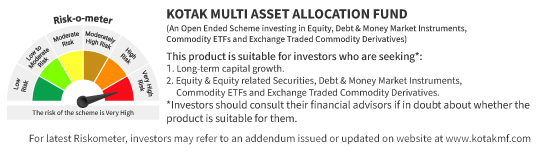
Kotak Multi Asset Allocation Fund
Investors may consult their Financial Advisors and/or Tax advisors before making any investment decision. This Article is for information purposes only. The views expressed in this Article do not necessarily constitute the views of Kotak Mahindra Asset Management Company or its employees. The company makes no warranty of any kind with respect to the completeness or accuracy of the material and articles contained in this Article. The information contained in this Article is sourced from empaneled external experts for the benefit of the customers and it does not constitute legal advice from the Bank. The Company, its directors, employees and the contributors shall not be responsible or liable for any damage or loss resulting from or arising due to reliance on or use of any information contained herein. Tax laws are subject to amendment from time to time. The above information is for general understanding and reference. This is not legal advice or tax advice, and users are advised to consult their tax advisors before making any decision or taking any action. These materials are not intended for distribution to or use by any person in any jurisdiction where such distribution would be contrary to local law or regulation. The distribution of this document in certain jurisdictions may be restricted or totally prohibited and accordingly, persons who come into possession of this document are required to inform themselves about, and to observe, any such restrictions.
MUTUAL FUND INVESTMENTS ARE SUBJECT TO MARKET RISKS, READ ALL SCHEME RELATED DOCUMENTS CAREFULLY.