4 Feb 2026
For decades, Greenland was often seen as a distant, frozen landmass, a remote Arctic island covered in ice, far removed from global economic and political conversations. But that perception is changing rapidly. Global powers like the US, China, Russia and the EU are paying close attention. Why? It’s a mix of location, resources, climate change and big-power rivalries. Greenland shows key 21st-century issues: security fights, green energy shifts, climate worries and resource needs. In short, what was once a frozen spot is now key to global futures.
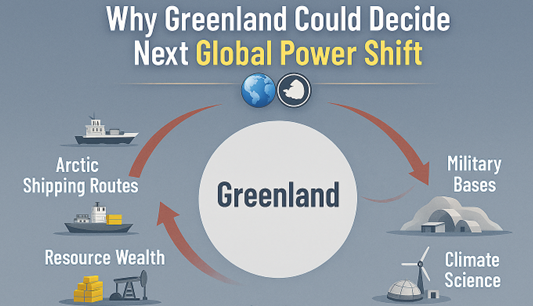
To understand Greenland’s present importance, it is essential to look at its historical evolution. The island was shaped by centuries‑old Indigenous Inuit culture and later Norse settlements, before being colonized by Denmark in 1721. Greenland remained a Danish colony for over 200 years, gaining Home Rule in 1979, which allowed limited self‑administration. This autonomy was significantly expanded with Self‑Government in 2009, granting Greenland control over key areas such as justice and natural resources and recognizing its right to self‑determination. Today, while Greenland manages most domestic affairs, Denmark continues to oversee foreign policy, defence and monetary matters, supported by an annual financial grant.
(Source: Statsministeriet Greenland)
Greenland became strategically important during World War II when Denmark was occupied by Nazi Germany, prompting the United States to step in to prevent the island from falling under German control. Its Arctic location made it a critical gateway between North America and Europe, ideal for monitoring air and naval movement across the North Atlantic. This importance carried into the Cold War, as Greenland lay beneath the shortest flight paths for Soviet missiles and bombers targeting the U.S. The 1951 US–Denmark defence agreement formalized this role by allowing permanent American bases, including Pituffik Space Base (formerly Thule Air Base), cementing Greenland’s long-term strategic value. U.S. military presence began in the 1940s.
(Source: congress.gov)
Geography is Greenland’s first and biggest advantage.
Greenland lies between North America, Europe and the Arctic Ocean, acting almost like a bridge connecting the Western hemisphere with Eurasia. Although on a rectangular map it may appear tucked away at the corner, in reality Greenland occupies one of the most important strategic positions on Earth. Its location makes it critical for monitoring trans-Atlantic movement, both commercial and military.
The US sees Greenland as crucial for defence. It hosts Pituffik Space Base (once Thule Air Base), used for spotting missiles early and tracking space. Greenland is part of the GIUK Gap (Greenland-Iceland-UK), a choke point for anti-submarine work in the Cold War. Today, it helps monitor Russian ships in the North Atlantic and Arctic. Though its war value dipped after the Cold War due to tech changes, US spending there has been up and down.
Climate change is the second major driver of Greenland’s rising importance.
The Arctic is warming faster than any other region in the world. According to the IPCC (Intergovernmental Panel on Climate Change), Arctic sea ice has declined by over 12% per decade since 1978 and multi-year ice has dropped by nearly 90% since 1979. Scientists now warn that the Arctic Ocean could see its first ice-free summer as early as the 2030s.
(Source: https://science.nasa.gov/earth/explore/earth-indicators/arctic-sea-ice-minimum-extent/)
This warming is transforming Greenland’s role in the world.
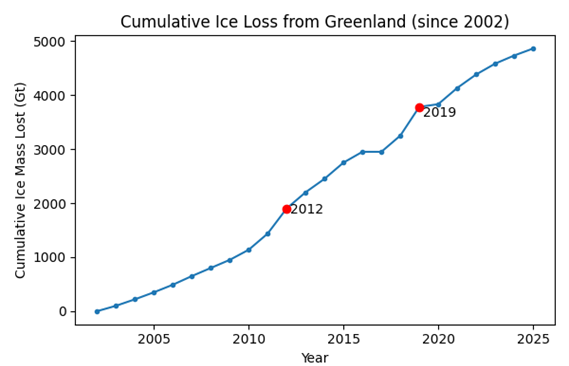
(Source: www.arctic.noaa.gov, As per latest data available)
For centuries, thick ice acted as a natural barrier. But as the ice melts, Greenland is shifting from being a frozen frontier to becoming an accessible strategic gateway.
This has profound implications not just for Greenland, but for global climate systems, trade routes and resource exploration.
This matters because rising seas threaten coastal cities and communities worldwide. Every millimetre of sea-level rise means more frequent flooding on coasts from Mumbai to Miami. And Greenland is a major contributor to sea-level rise. If climate change persists unabated, ice loss could accelerate further. Over the very long term, if all of Greenland’s ice were to melt, global sea level would jump by about 7 meters (23 feet) (flooding countless coastal regions. That doomsday scenario would take centuries, but partial melting this century is already expected to raise seas enough to redraw shorelines. Beyond sea level, Greenland’s melting can also disrupt ocean currents. The influx of cold freshwater into the North Atlantic may weaken the Gulf Stream, affecting weather patterns in Europe and beyond.
(Source: www.arctic.noaa.gov, As per latest data available)
Shorter shipping routes
As Arctic ice retreats, Greenland is also becoming central to the future of global trade.
New polar shipping corridors are emerging, including:
- The Northern Sea Route
- The Northwest Passage
- Potential future transpolar routes across the Arctic Ocean
These routes can significantly shorten travel distances between Asia and Europe. For example, Arctic routes could reduce transit time by 10–15 days and lower shipping costs by up to 50%, compared with traditional routes via the Suez Canal.
| Route | Distance (nautical miles) | Location | Ice Conditions / Accessibility |
|---|---|---|---|
| Suez Canal Route | ~11,000 | Through Suez Canal | Open year-round, widely used |
| Northern Sea Route | ~8,000 | Arctic waters | Only partially ice-free for a few months each year |
Source: www.arctic.noaa.gov, NOAA- National Oceanic and Atmospheric Administration
In this context, the Baffin Bay and Davis Strait along western Greenland linking the Arctic to the North Atlantic are gaining importance as a potential “new Suez–like gateway,” a trend reinforced by China’s promotion of a “Polar Silk Road” to secure shorter, more resilient trade routes between East Asia, Europe and North America.
Untapped wealth of Rare Earths and Critical Minerals
Greenland now occupies a central position in global strategic discussions due to its vast geological wealth. Beneath its icy surface lies an extraordinary concentration of untapped resources that could redefine Western energy independence.
- Rare Earths and Uranium: Essential for advanced electronics and nuclear power.
- Base Metals: Significant deposits of zinc and copper required for electrical grids.
- EU Strategic Materials: Surveys indicate that 25 of the 34 critical raw materials listed by the European Union are present on the island. (Source: European Parliament, October 2025, As per latest data available)
This positioning makes Greenland a future cornerstone of mineral security. As the ice recedes, the accessibility of these treasures increases, drawing the eyes of major global powers.
Greenland’s estimated 1.5 million metric tons of rare earth reserves exceed those of countries like Canada and South Africa. Yet the island has never had commercial rare earth production.
Global Rare Earth Reserves and Production (2024)
| Country | Reserves (Metric Tons) | Rare Earth Production 2024 (Metric Tons) |
|---|---|---|
| China | 44.0M | 270,000 |
| Brazil | 21.0M | 20 |
| India | 6.9M | 2,900 |
| Australia | 5.7M | 13,000 |
| Russia | 3.8M | 2,500 |
| Vietnam | 3.5M | 300 |
| United States | 1.9M | 45,000 |
| Greenland | 1.5M | 0 |
| Others | 2,584.5K | 60,230 |
| World Total (rounded) | >90,000,000 | 390,000 |
Source: USGS Earth Explorer, As per latest data available
Environmental protections, infrastructure constraints and local political opposition have slowed development. Still, as supply chain security becomes a priority for major economies, Greenland’s position is becoming harder to ignore.
Top Rare Earth Mines by Ore Grade
| Rare Earth Mine | Country Location | Ore Grade of Reserves (%) |
|---|---|---|
| Tomtorskoye | Russia | 14.5 |
| Steenkampskraal | South Africa | 8.68 |
| Mt Weld | Australia | 6.4 |
| Mountain Pass | United States | 5.96 |
| Ngualla | Tanzania | 4.8 |
| Ozango | Angola | 3.04 |
| Kangankunde | Malawi | 2.9 |
| Nolans Bore | Australia | 2.9 |
| Bayan Obo | China | 2.555 |
| Wicheeda | Canada | 2.43 |
| Nechalacho | Canada | 1.7 |
| Kvanefjeld | Greenland | 1.43 |
| Songwe Hill | Malawi | 1.16 |
Source: S&P Global, As per latest data available
US’ interest in Greenland is driven by more than symbolism. Rare earths are essential for advanced manufacturing, clean energy technologies and military hardware. With China firmly entrenched as the dominant supplier, policymakers in Washington are increasingly focused on alternative sources. These minerals are the critical backbone of 2026. They are in your smartphone, your EV battery, your wind turbines and your defence systems. Currently, China dominates the global supply of rare earths, a monopoly that makes the West deeply uncomfortable. Greenland offers a huge, albeit difficult, alternative. Other nations are betting on the fundamental supply chains of the next fifty years.
Greenland now sits at a crossroads where three massive forces collide:
- Economic Opportunity: The chance to break resource monopolies and open new trade routes.
- Geopolitical Competition: The race between superpowers to claim "Arctic Influence."
- Environmental Risk: The paradox that the very thing making these resources accessible i.e. climate change makes the ecosystem too fragile to exploit without massive consequences.
Greenland now sits at the centre of intensifying geopolitical competition, as global powers seek strategic advantage from a rapidly warming Arctic whether through new shipping routes, military positioning or access to critical natural resources. Yet these ambitions intersect with the aspirations of Greenland’s ~57,000 residents, who increasingly seek greater autonomy from Denmark and aim to protect their cultural identity and environment. Despite this growing political confidence, Greenland remains structurally dependent on Denmark. The annual block grant of DKK (Danish Krone) 3.4–3.9 billion still accounts for over 20% of GDP and more than half of public spending. This reliance is set to continue in the near term, reinforced by Denmark’s newly approved DKK 1.6 billion (2026E–2029E) package to upgrade ports, healthcare, infrastructure and strengthen long‑term welfare resilience. As the island gains strategic relevance, its people are asserting a stronger voice, reminding the world that Greenland’s future cannot be shaped solely by outside powers. Ultimately, Greenland is becoming not just a geopolitical prize, but an emerging actor navigating its own path amid global transformation.
(Source: https://www.reuters.com/world/denmark-pledges-253-million-greenlands-infrastructure-healthcare-2025-09-16/, www.cia.gov, The World Factbook, cia.gov, https://www.trade.gov/country-commercial-guides/denmark-other-areas-kingdom-denmark)
Mr Arijit Dutta, Vice President, Kotak Mahindra AMC, adds: “Greenland is the new “Land of Opportunities” with huge unoccupied land base, strategic sea route, abundant natural resources including rare-earths and fuel. With climate change, as ice melts, this opportunity size increases, resulting in increased competition of nations for its control.”
Kotak Mahindra Asset Management Company Limited (KAMAMC) is not guaranteeing or promising any returns/futuristic returns. The stocks/sectors mentioned in this slide do not constitute any recommendation and Kotak Mahindra Mutual Fund may or may not have any future position in these sectors/stocks. These materials are not intended for distribution to or use by any person in any jurisdiction where such distribution would be contrary to local law or regulation. The distribution of this document in certain jurisdictions may be restricted or totally prohibited and accordingly, persons who come into possession of this document are required to inform themselves about, and to observe, any such restrictions.
MUTUAL FUND INVESTMENTS ARE SUBJECT TO MARKET RISKS, READ ALL SCHEME RELATED DOCUMENTS CAREFULLY.